
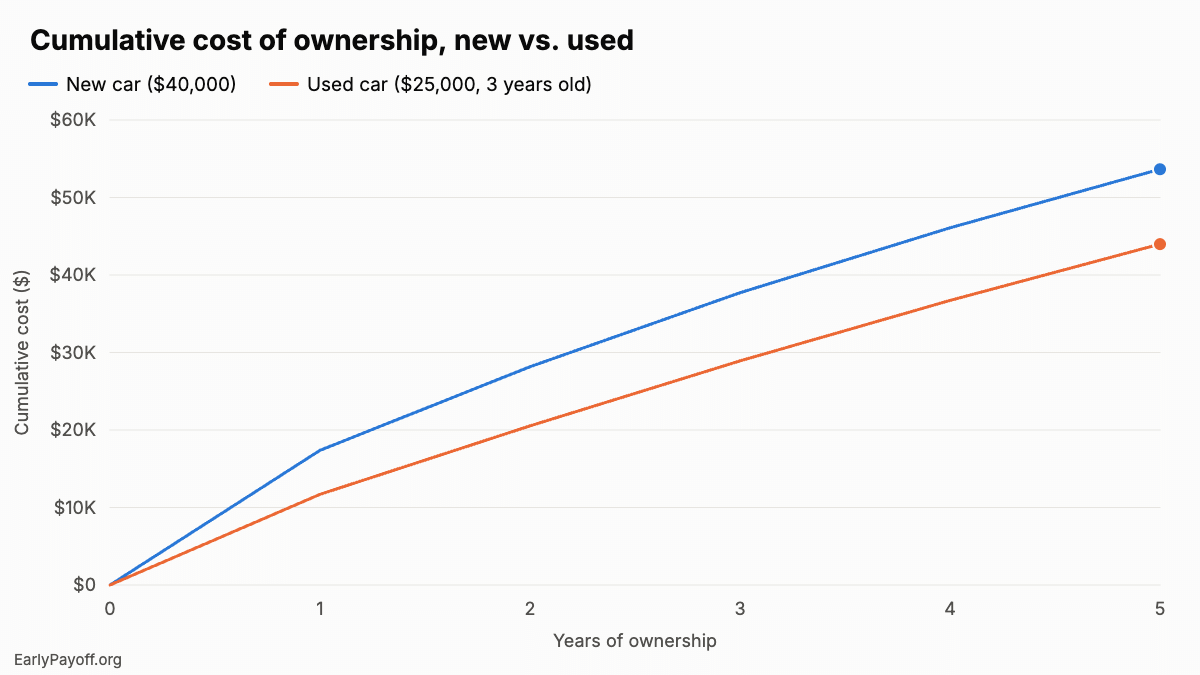
To calculate the true cost of a car, add up everything you will spend over the years you own it: the value the car loses (depreciation), loan interest, sales tax and fees, insurance, fuel or charging, maintenance and repairs, and registration. Then divide by the months or miles you drive. In an EarlyPayoff example, a $40,000 new car costs about $53,650 over five years, or $894 a month. A $25,000 three-year-old used car costs about $43,986, or $733 a month. Neither number is the sticker price, and neither is the loan payment.
Key takeaways
- Depreciation is usually the largest single cost of a new car. It was 42% of the five-year total in the new-car example, and it never shows up on a bill.
- Running costs add up fast. With regular gasoline at $4.331 a gallon (EIA, week of Oct 12, 2026), fuel alone is about $1,624 a year for a 32-mpg car driven 12,000 miles.
- The used car in the example cost $9,664 less over five years, but it carried higher assumed repair costs and a higher loan rate.
- The IRS business mileage rate of 76 cents a mile (July–December 2026) is a useful sanity check. At 60,000 miles it implies $45,600, between the two examples.
- Car costs are moving in different directions in 2026. Over the 12 months to September 2026, consumer prices rose 5.8% for vehicle maintenance and repair, fell 5.0% for vehicle insurance and fell 1.5% for used cars (BLS CPI).
The seven costs to include
Total cost of ownership works for any car, new or used, gas or electric. List each cost per year, then add them up.
- Depreciation: purchase price minus what the car is worth when you sell or trade it. You pay it at the end, when you get less back.
- Financing: interest paid on the loan, not the full payment. The principal you repay is already captured in the purchase price and depreciation.
- Sales tax and fees: state and local taxes, title and registration at purchase, plus dealer documentation fees. Taxes and government fees are set by your state, while dealer fees can be negotiated (CFPB, as of Oct 2026).
- Insurance: your actual quote for this specific car. Lenders require insurance on a financed car, and full coverage costs more than liability only.
- Fuel or charging: miles per year ÷ fuel economy × price per gallon, or miles × kWh per mile × electricity price.
- Maintenance and repairs: scheduled service, tires, brakes and repairs, which tend to rise as a car ages and its warranty ends.
- Registration and annual taxes: renewal fees and, in some states, an annual property or excise tax on the vehicle.
Parking, tolls and inspections can matter too. Add them if they apply to you.
Worked example: new vs. used over five years
The example compares two gas cars driven 12,000 miles a year. Where a reliable public figure exists, the example uses it:
- Gasoline: $4.331 a gallon, the US average for regular in the week of October 12, 2026 (EIA). It is held flat for five years.
- New-car loan rate: 7.14%, the Federal Reserve’s 2026 Q2 average for a 60-month new-car loan at commercial banks (G.19, released Oct 7, 2026).
- Insurance: $1,438 a year, the NAIC’s 2023 countrywide average premium for a policy with liability, collision and comprehensive coverage (published June 2025). It is the latest national figure available and is held flat.
Everything else is an illustrative assumption you should replace with your own numbers. That includes prices, the 6% sales tax, $600 in fees, $4,000 down, the used-car loan rate (set 2 points above the new-car rate), the resale values, fuel economy, repairs and $250 a year in registration.
- New car: $40,000 price, 32 mpg. $39,000 financed for 60 months at 7.14% ($774.83 a month). Assumed to be worth 43% of its price, $17,200, after five years.
- Used car: three years old, $25,000 price, 28 mpg. $23,100 financed for 60 months at 9.14% ($481.09 a month). Assumed to be worth 54% of its price, $13,500, after five years. Repairs are assumed to start higher and rise each year.
| Five-year cost | New car ($40,000) | Used car ($25,000) |
|---|---|---|
| Depreciation | $22,800 | $11,500 |
| Loan interest | $7,490 | $5,765 |
| Sales tax and fees at purchase | $3,000 | $2,100 |
| Fuel | $8,121 | $9,281 |
| Insurance | $7,190 | $7,190 |
| Maintenance and repairs | $3,800 | $6,900 |
| Registration | $1,250 | $1,250 |
| Total | $53,650 | $43,986 |
| Per month | $894 | $733 |
| Per mile (60,000 miles) | $0.89 | $0.73 |
Three things stand out.
Depreciation dominates the new car. The new car loses $22,800 in value over five years, 42% of its total cost. The used car loses $11,500, 26% of its total, because the steepest early drop already happened to its first owner.
Running costs dominate the used car. Fuel, insurance, maintenance and registration make up 56% of the used car’s total, against 38% for the new car. A less efficient used car with rising repairs can lose much of its price advantage, so get a pre-purchase inspection and check its fuel economy.
The payment is a poor guide. The new car’s payment is $293.74 a month higher than the used car’s. Its true monthly cost is only $161 higher, because more of the used car’s cost comes from repairs and fuel that the payment does not show.
Checking your numbers against the IRS mileage rate
The IRS sets a standard mileage rate each year from an annual study of the fixed and variable costs of operating a car. For 2026, it was 72.5 cents a mile from January through June. Because of higher fuel prices, the IRS raised it to 76 cents a mile from July 1 through December 31, 2026 (IRS, as of Oct 2026).
At 76 cents, 60,000 miles works out to $45,600. That falls between the example used car ($0.73 a mile) and new car ($0.89 a mile). If your estimate comes out far below 70 cents a mile for a newer financed car, look again at depreciation and repairs. If it comes out far above 90 cents, you may be buying more car than you need.
The rate reflects average business driving and is meant for tax deductions and reimbursements. It is a benchmark, not a prediction for your car.
How to get each number for your own car
- Price and taxes: use the out-the-door price from a written quote and your state’s tax rate.
- Resale value: look up today’s value for the same model at the age and mileage you would sell it. That shows how fast similar cars have lost value. Used-vehicle prices also move with the market. The BLS used-car price index fell 1.5% over the year to September 2026, after rising in 2025.
- Financing: use a real preapproval. Our guide on negotiating a car loan rate shows how much a point of rate costs. Interest on a loan for a qualifying new, US-assembled personal vehicle may be deductible for 2025–2028, which slightly lowers the after-tax cost of financing (IRS, as of Oct 2026).
- Insurance: get quotes for the exact vehicle before you buy. National averages hide large differences by state, driver and vehicle. The BLS motor vehicle insurance index was down 5.0% over the year to September 2026, after large increases in 2023 and 2024.
- Fuel: use the EPA combined mpg for the model and the EIA price for your region. Gas prices move. On the new car, $3.50 gas would cut five-year fuel costs by $1,558, and $5.00 gas would add $1,254.
- Charging an EV: at the July 2026 US residential average of 18.31 cents per kWh (EIA) and an assumed 0.30 kWh per mile, home charging costs about $0.055 a mile, or $659 a year at 12,000 miles. That compares with $0.135 a mile for gas at 32 mpg. Public fast charging usually costs more.
- Maintenance: use the manufacturer’s schedule, the warranty’s end date and repair estimates for the model. Repair prices rose 5.8% over the year to September 2026 (BLS CPI).
- Trade-in: if you still owe on your current car, add any negative equity to the new car’s cost. See how to trade in a car you still owe on.
Once you have a monthly total, put it in your budget alongside housing and debt payments. Our guide on building a budget that works can help.
Risks and blind spots in a cost comparison
- When you will not keep the car for the period you modeled. Selling a new car after two years usually costs more per year than keeping it for five, because depreciation is front-loaded.
- When the used car’s history is unknown. A used car only saves money if it does not need a major repair. Budget a cushion, or skip a car that fails an inspection.
- When the cash outlay matters more than the total. The comparison counts depreciation, which you do not pay until you sell. If cash flow is tight, also look at the monthly payment plus insurance, fuel and repairs.
- When you ignore your other goals. Money that goes to a car is not paying down a mortgage or high-rate debt. A cheaper car can free up money for both.
Frequently asked questions
What is the biggest cost of owning a car?
For a new car, usually depreciation. In the example, the new car lost $22,800 in value over five years, more than its fuel, insurance and maintenance combined. For an older used car, fuel, insurance and repairs often matter more.
Is it cheaper to buy new or used?
Often used, because the first owner absorbs the steepest depreciation. In the example the used car cost $9,664 less over five years. A used car with poor fuel economy, a high loan rate or costly repairs can close that gap, so run the numbers for the specific cars you are considering.
Can I just use the IRS mileage rate as my cost?
As a rough benchmark, yes. The 2026 business rate of 76 cents a mile (July through December) reflects average fixed and variable costs. Your car’s actual cost depends on its price, depreciation, financing and where you live.
How do I estimate depreciation before I buy?
Look up the current value of the same model a few years older with similar mileage, and compare it with its price when new. That shows how fast similar cars have lost value. Repeat the check for the specific trim and mileage you expect to have when you sell.
Does an electric car always cost less to run?
Not always. Home charging at average US electricity prices costs much less per mile than gas, but the purchase price, insurance and any public charging fees vary. Compare the full total, not just fuel.
Sources
- U.S. Energy Information Administration, Gasoline and Diesel Fuel Update (Oct 14, 2026 release), accessed Oct 2026
- EIA, Electric Power Monthly, Table 5.6.A Average Price of Electricity to Ultimate Customers (July 2026), accessed Oct 2026
- Federal Reserve, Consumer Credit – G.19 (released Oct 7, 2026), accessed Oct 2026
- NAIC, 2023 Auto Insurance Database Average Premium Supplement (June 2025), hosted by the Maryland Insurance Administration, accessed Oct 2026
- IRS, Standard mileage rates, accessed Oct 2026
- IRS, Internal Revenue Bulletin 2026-29, Announcement 2026-11 (revised 2026 mileage rates), accessed Oct 2026
- IRS, IR-2025-128, 2026 business standard mileage rate, accessed Oct 2026
- BLS, CPI-U Used cars and trucks (CUUR0000SETA02), accessed Oct 2026
- BLS, CPI-U Motor vehicle insurance (CUUR0000SETE), accessed Oct 2026
- BLS, CPI-U Motor vehicle maintenance and repair (CUUR0000SETD), accessed Oct 2026
- CFPB, What things can I negotiate when shopping for a car or auto loan?, accessed Oct 2026
- IRS, Tax deductions for working Americans and seniors (No tax on car loan interest), accessed Oct 2026
This article is general education, not individualized financial, tax or legal advice.